Resisting empire, promoting peace: Churches confront the Russian world ideology
2.12.2025
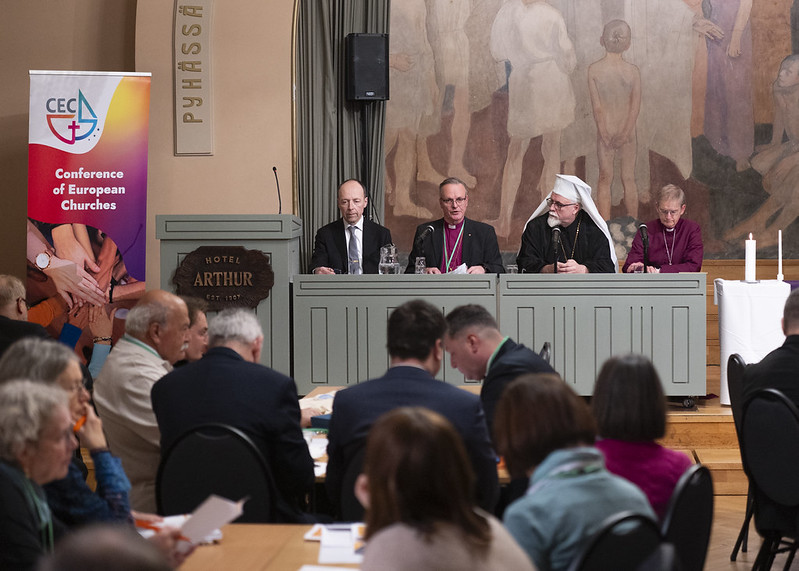
Ladies and gentlemen, brothers and sisters in Christ.
It is my great pleasure on behalf of the Evangelical Lutheran Church of Finland to extend to you all a very walm welcome to Finland. It is an honor to have this kind of conference in our country.
I would also like to thank the Conference of the European Churches for arranging this most important gathering. It is crucial that church leaders, academic theologians and other experts come together to discuss, how peace in Ukraine will be reached and what is the role of churches in this process. What happens in Ukraine has far-reaching consequences not only for Ukraine but also for the whole Europe and the future of Christianity in this continent.
Let me begin with mentioning that last September I had the privilege of visiting Ukraine as a member in the Nordic church leaders’ delegation. I cordially thank both the Orthodox Church in Ukraine as well as the German Evangelical Lutheran Church of Ukraine for your hospitality during our journey. It was a profoundly touching experience. We saw a country under constant attacks and air alerts. We came to understand the brutality of war in all its tragedy. It certainly is appropriate that pathways to peace could be found and followed as soon as possible.
As a Finnish church leader, having seen and heard what has happened during the past years, there are some points I would like to take up here.
I have been following with concern how, in both political and ecumenical discourse, there have been serious setbacks in how the war in Ukraine and Russia’s role in it are being addressed. In the months following the outbreak of the war, there was no hesitation in naming Russia as the aggressor, nor in speaking openly about the war crimes committed by Russia. The deeply problematic role of the Russian Orthodox Church—as a voice articulating the justifications for the war of aggression and as a supporter of military actions—was also brought to light without reservation.
However, it is my impression that the situation has changed in recent times. Today, we are hearing statements from various parts of the world, including Europe and the United States, that either echo Russian rhetoric or, alternatively, avoid taking a stance on the war—as if this were a conflict between two equally responsible parties, in which neutrality is the appropriate response. Unfortunately, this shift has also been evident within the World Council of Churches. It was disconcerting to learn that the WCC Central Committee, a member of which I am and which met in Johannesburg in June, was unable to adopt — even after some softening in the content — a joint statement by the Nordic Lutheran and Orthodox churches concerning the children abducted from Ukraine to Russia.
Speaking personally, I find it totally impossible to understand the arguments why Russia decided to attack Ukraine in the first place. And consequently, I find it extremely difficult to understand why these arguments seem to be valid and acceptable to so many.
I would not say this aloud unless I thought that the role of inter-church organizations, like the Conference of European Churches and the World Council of Churches, is important in this respect. As long as there are religious arguments given to any kind of military attack against an independent nation, the churches must be involved in addressing religious hegemonistic rhetoric. In order to strengthen the role of churches in countries attacked by another country, those churches should be able to participate in the work of inter-church organizations. That is why I greatly appreciate the role of CEC for arranging this conference. Likewise, it is important for the European member churches of the WCC work together in supporting the membership application of the Orthodox Church of Ukraine to the World Council of Churches.
All efforts to find pathways to a lasting and just peace in Ukraine are now most welcome. The present activity by the US and Russia is important, but it needs the participation of Europe and, most importantly, of Ukraine itself. I hope and pray that this conference will discern those paths. The issue is both urgent and difficult. This conference may prove to be influential, far-reaching and fruitful. For this end we need to be open, honest and willing to understand the various standpoints of the participants.
Last September, we bishops in the Bishops’ Conference of the Evangelical Lutheran Church of Finland published a booklet with the name The Call to Peace. In it we Finnish bishops state the following:
A peace that is just requires the realisation of internationally recognised human rights and equality. This means a conflict can only be resolved if the parties are prepared to negotiate concerning their own interests and expectations. The victims of war must be heard as the experts they are, and civilians must be heard when piecing together the shattered structures of society. People of all ages and backgrounds must be involved in making decisions.
Conflict is caused by the unjust distribution of power and resources, so a great deal of discussion is warranted. A successful peace process restores the dignity of victims of war, holds the culpable accountable and includes both as equals in society.
From the Christian perspective peace is God’s will, God’s work and God’s gift. To work for peace is to follow God’s will.
May God bless our conference.
Photos: CEC/Kinga Majewska. Speaker of the Finnish Parliament Jussi Halla-aho, The Archbishop of Turku and Finland Tapio Luoma, Elia, Archbishop of Helsinki and All Finland and Dagmar Winter, Vice-President of CEC talked at the opening session.