An address to His Holiness Pope Leo XIV, at the private audience 19 January 2026
19.1.2026
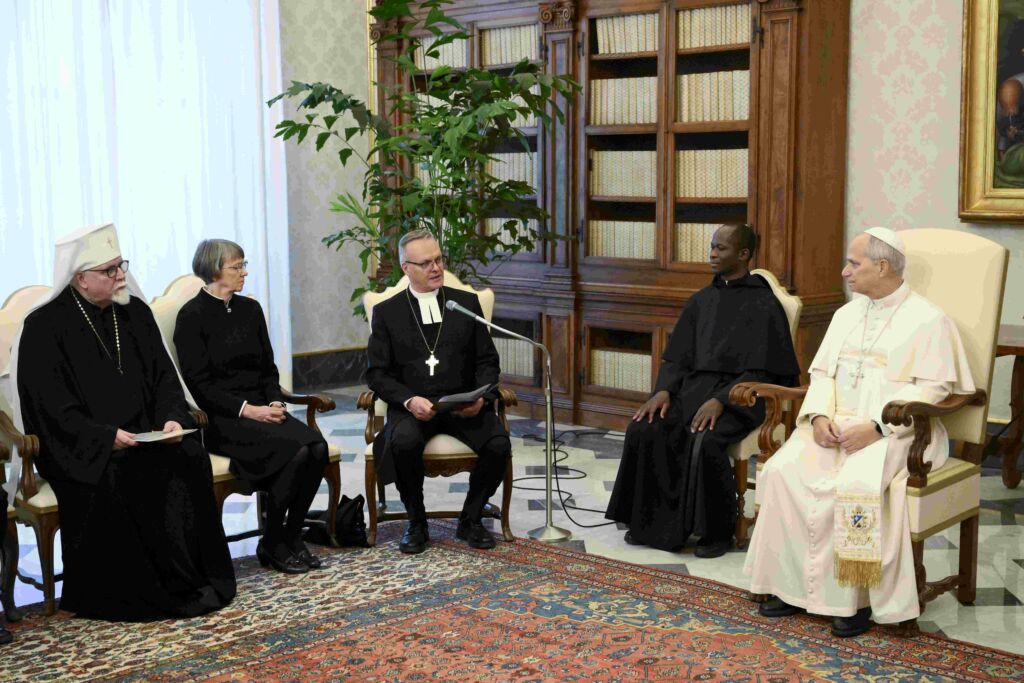
Your Holiness,
We are brought here today by an ecumenical tradition that started in 1985 with the first ecumenical celebration of St Henry’s Mass in Rome. Today, as the 55th bishop on the seat of St Henry, I am especially delighted to stand here with the Finnish Catholic Bishop Raimo Goyarrola and the primate of the Finnish Orthodox Church, Archbishop Elia. Representing our three Christian traditions, we bring you, Holy Father, the greetings of Finnish Christians. That we stand here together and present our common greetings is a visible sign of Finnish ecumenism.
We are filled with special joy on our visit this year. The Archdiocese of Turku is celebrating its 750th anniversary.
According to historical research, Christian influences began to arrive in Finland from the west as early as the sixth century. In the 12th century, the Vatican organised Scandinavian Christianity into three ecclesiastical provinces. The ecclesiastical jurisdiction of Uppsala applied to Finnish Christians, with Orthodox Christians in eastern Finland being the exception. In the mid-13th century, the popes repeatedly reminded the Archbishop of Uppsala that a diocese chapter had to be established in the Finnish diocese to administer church property and oversee the election of bishops. Our predecessors must have been slow to take up the task! While we lack precise information on the exact year the Turku Cathedral Chapter began its operations, it is estimated to have been around 1276, marking its 750th anniversary this year.
Although the establishment of the diocese chapter in Turku was primarily about the organisation of (Western) Christianity in Finland, it had another significance. It marked the beginning of Finland’s development as an administrative and cultural region, under the kingdom of Sweden. This is why the anniversary is called and celebrated as the ‘Anniversary of Education and Culture’ in Finland: it marked the birth of Finnish public administration and a significant milestone of Finnish civilizational development.
This development was initiated by your predecessor, Holy Father. That is why the President of the Republic of Finland, Alexander Stubb, wanted to send you his greetings.
Finland looked different 750 years ago, but one thing has remained the same. People have always searched for meaning, connection, and hope. In our present time, your messages, Holy Father, underlining the significance of the rule of law and human dignity are warmly welcomed.
There is a lot to be done in this broken world, which yearns for tranquility and peace. As leaders of the Finnish churches, we are committed to promoting ecumenism in many different ways. We have doctrinal dialogues ahead with Catholics and Orthodox Christians, as well as preparations for the joint celebration of the anniversary of the Augsburg Confession. However, we also wish to foster understanding and peace with other religions and within Finnish society.
As representatives of three Christian traditions, we are grateful that you, Holy Father, have inspired us through your words and actions. On this unique occasion and on behalf of our three churches, I hereby extend to Your Holiness our cordial invitation to visit Finland. It would be a profound blessing for our nation to welcome you among us.
We wish to assure you of our prayers, Holy Father, that Almighty God may grant you the power, courage, wisdom and love required for your invaluable ministry of building unity within the Church and fostering peace throughout the world.
Photo: Vatican Media